What was the last film you watched?

Seaviewer

Telly Talk Warrior
Top Poster Of Month
LV
9
 
Awards
20
Seeing Richard Lester's name in the credits gave me mixed feelings. I know his Sixties vehicles include those Beatles films but - never having seen those - my mind instantly goes to him ruining the tone of the Superman film series with an overload of quick and "comedy". Still, I made peace with continuing by telling myself this film was billed as an actual comedy anyway.

Michael Crawford is already demonstrating the physicality for which he would go on to be renowned.
My mind of course goes immediately to the Beatle films but Lester also directed the 1967 anti-war comedy How I Won the War starring Crawford and (somewhat improbably) John Lennon.
 

Angela Channing

Telly Talk Veteran
LV
19
 
Awards
52
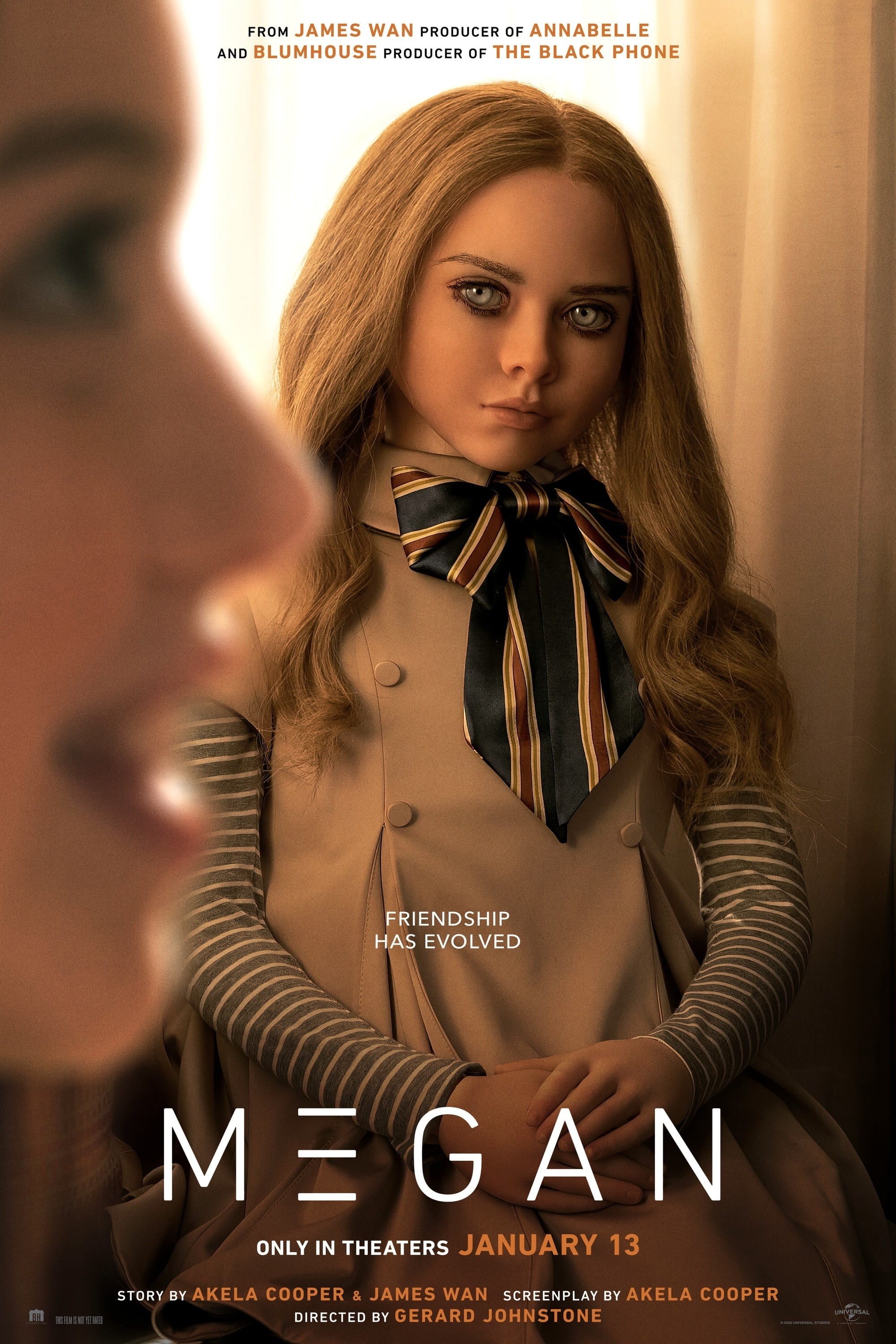
M3GAN (2023)

b2b6afda424bb871b34c8ca843bcdabc.jpg


The cute doll that becomes the scary doll that becomes the killer killer doll has been done many times before in films but rarely as good as this.

Cody is a young girl whose parents die in an accident so she has to live with her Aunt Gemma who is a engineer and toy designer at a major toy manufacturer. Her current work is on M3GAN (Model 3 Generative Android), a life-like artificial intelligence doll who learns from its environment to develop into a more customised play mate for the child to which it is assigned. Cody becomes attached to M3GAN and the android helps her to deal with her bereavement but M3GAN becomes overly protective of Cody in the process with murderous consequences.

Although I've read some people describe it as a horror film, it isn't really although it does have a few scary scenes in it. It's more of a thriller and there are some really anxious moments in it. I totally loved the film and thought it was clever, interesting, funny and tense and well worth watching.
I previously said I loved the original M3GAN film so I was looking forward to seeing...

M3GAN 2.0

MV5BOWM0NjdkYTUtZTc3Yy00ZmFmLWEwOTQtYTBlM2QzZTE3ODIxXkEyXkFqcGc@._V1_.jpg


The unimaginative poster should have been a clue that this wasn't going to be anywhere near as good as the original. M3GAN 2.0 attempts to build on the eerie charm of its predecessor but just a formulaic film leaning heavily on recycled plots and predictable scares. M3GAN has been revived to take on a Amelia, another AI robot that has gone rogue. Part of the plot reminded me of Terminator 2, but a very poor and less exciting version. Not particularly scary, not particularly thrilling.
 

Mel O'Drama

Admin
LV
16
 
Awards
44
Longlegs (2023)

iu


The image on Prime and their and one-sentence description gave me Nineties crime procedural vibes. I knew better than to hope for The Silence Of The Lambs, but had hopes it might be in the vein of the raft of thrillers that followed it: (Copycat, The Bone Collector, Seven, etc.).

I kind of got my wish. Like most of the films above, it pairs the determined young newbie with the seasoned, world-weary old-school pro, and has one of them haunted by an earlier trauma. It gives us the disturbed serial killer.

Of course there's the dark, dark cinematography. Which isn't a criticism, since it looks sumptuous and shadowy, with warm orange light occasionally piercing the gloom. One thing this film has in spades is atmosphere. And some moments and imagery are disturbing.

The casting is interesting enough. Most of those names with which I'm familiar are playing roles unlike anything I've seen them play before. I forgot I'd seen Alicia Witt's name and consequently didn't recognise her for the entire film. Possibly not entirely surprising since I'm most familiar with her as the smart-mouthed Final Girl from 1998's Urban Legend and as Cybill's smart-mouthed daughter. Still, though, this is a definite departure. Likewise, I mostly know Blair Underwood as one of the prettiest of the PYTs on L.A. Law so spent some time wondering "is he/isn't he"?

I didn't know the lead actress, which was a help as I was able to appreciate her performance on its own merits. Must confess had I seen photos of her with platinum blonde hair wearing next to nothing before watching the film I may have pre-judged.

It's a shame the film announced "And Nicholas Cage as Longlegs" over the opening credits, since I'd like to have experienced this performance without the potential judgement attached to his reputation from various poor vehicle and character choices. I don't think I would have recognised him, which would have been a plus for me. They should have held off on showing his name until the end, like with Kevin Spacey in Seven (this film ripped off Seven's backwards-scrolling end credits, so why not go the whole way). As it is, I couldn't help being taken out of the story by thinking how strange it was to see him made up like an eccentric great-aunt*.

Wish fulfilment can ultimately be unfulfilling, and that was the case here. Tonally, it did indeed tap into those Nineties crime procedurals, but I found myself feeling frustrated that I could see bits and pieces of all of them that didn't fit to a cohesive whole. It ended up feeling more like a poor man's recreation than a love letter. The character of Longlegs began to irritate me for the same reasons. The performance combined mannerisms and traits that have been praised in other antagonists who are big characters in their own right: Buffalo Bill; Pennywise; Joker; Leatherface. There's a lot going on here. Too much. Which is a symbol of the film overall. It feels everything but the kitchen sink is thrown at it in the hope that something sticks and lands with the audience. For me it just tries to be too many things to too many people, and ultimately feels very needy.

This shows in the plot as well. As a straight procedural it would have been a better film, but it then overcomplicates things by going into more supernatural genres. The warning bells come early in the film, with allusions to the protagonist's psychic abilities. I possibly could have made peace with this. And the satanic worship element was fine. But combining both, and throwing in (I kid you not) dolls that control people's minds just took it from potentially sublime to ridiculous.

Despite my comments, I found it watchable and thought it was a very promising film... The very reason it ended up disappointing.


​


* The film was apparently criticised for transphobia due to its lipstick-wearing serial killer, but I see this element more as an accidental byproduct of Cage attempting to channel Heath Ledger/Joaquin Phoenix/Ted Levine/Whoever Else in the hope of receiving the same level of adulation.

​
My mind of course goes immediately to the Beatle films but Lester also directed the 1967 anti-war comedy How I Won the War starring Crawford and (somewhat improbably) John Lennon.

Wow. That's certainly an unlikely pairing. Looking at the cast I see a lot of familiar names from the world of British light entertainment, so consider this one added to my viewing bucket list.
 

Mel O'Drama

Admin
LV
16
 
Awards
44
Heretic (2024)

iu


I was pleased to watch this with little knowledge of the film, other than the poster of Hugh Grant looking a little sinister, and a brief synopsis on Prime about two missionaries knocking on the door of a host who plays cat and mouse with them (and the latter was, frankly, too much information. Can't we just hint rather than giving away anything beyond the first act?).

Something about the description gave suggestions of The Perfect Host with David Hyde Pierce, and The Owners with Sylvester McCoy and Rita Tushingham, both of which are kind of home invasion films in reverse. There are indeed similarities, with the difference here being that the people who enter the house with dark secrets are there trying to do good, even if they still have their agenda. They might be evangelists, but they're also somewhat invited guests at this home, since they have a list of people who have expressed interest in their faith, rather than knocking on random doors asking people if they've thought about their afterlife today.

It has to be said that I came close to aborting my viewing during the lengthy opening scene with the two girls on the bench. It was one of those "trying too hard" moments where the more it tried to clobber the audience round the head with its "naturalistic" dialogue, the more contrived it felt (the "detail" where the girl mispronounced pornography several times was particularly forced, badly executed and unfunny).

I'm very glad I persevered, though, because these faltering steps were far from representative of the film as a whole, and it really came to life the moment Hugh Grant opened the door. And, thanks to some deft writing and direction, the two female actresses turned out to be quite watchable as well, bouncing wonderfully off his intensity.

Hugh Grant greatly went up in my estimation when I watched Florence Foster Jenkins a couple of years ago, I felt he had potential to give a great performance here and really he did deliver. He swings effortlessly between being disarmingly charming and... something else entirely. The uncomfortably inappropriate turns the conversation quickly took really made me feel that sense of being on guard and questioning if it was just a bumbling series of mistakes or something much darker. All of which made good use of his image as the hapless, "nice-but-dim" romantic lead.

He has some terrifically memorable monologues and diatribes throughout, most of them regarding the way faith is sold and bought as he turns the tables on the messengers who become his captive audience. Like this one where he draws parallels between certain faiths, board games and the plagiarism thread that ran from The Hollies to Lana Del Ray via Radiohead.


If it has a failing, it's some of the situations being a little too extreme. In particular the discoveries made in the latter part of the film relating to other occupants stretched credulity and lost some of the reality that had, up to that point, made it so very unsettling.

Even so, this one was definitely worth a peek, and I'd probably watch it again.​
 

Seaviewer

Telly Talk Warrior
Top Poster Of Month
LV
9
 
Awards
20
Miracle on 34th Street (1973)
To mark "Christmas in July" this year I thought I'd watch this TV remake which I haven't seen in quite a long time. It used to be shown regularly, presumably because it was in colour, but when colorisation became a thing the original returned - until the 1994 remake came along. Now they don't show any of them but I have the original on DVD.
The first thing you notice is how fast Kringle walks, the whole thing is like it's on speed, and everyone speaks so sharply to each other. They've added scenes to explain things that don't need explanation, eliminating the miracle, but at the same time left out much of the character interaction.
The one thing that I really like remains the moment when Tom Bosley's judge adds his grandchildren's letters to the pile on the bench - but why did they think it was better to have the hearing in camera? It removes all the atmosphere.
 

Monzo

Telly Talk Enthusiast
LV
1
 
Awards
9
I saw the Lithuanian film "Slow," in which a dancer and an asexual sign language interpreter meet and fall in love. As they begin a relationship, they must figure out how to develop their own kind of intimacy.
It's the kind of film that's worth talking about because there are details that make me question whether it's realistic or not. In any case, the film is thought-provoking.
 

Mel O'Drama

Admin
LV
16
 
Awards
44
I've watched a couple of films over the last evenings. First up was...

Billy Elliot (2000)

iu


Why it's taken me a quarter of a century to finally watch this, though it's been somewhere on the periphery of my radar almost since the beginning.

I've since watched Jamie Bell as an adult actor in a film or two - most notably that pointless Fantastic Four film (or, as it was written on poster, "Fantfourstic"), so it was a little surreal to see him here as a mini version of who he would become. And he was just that, because this film takes a really refreshing approach to its focus on children. They're not the usual cutesy creatures we usually see - infantilised versions that match up with how adults see children. They're simply smaller people, honestly written and speaking as I remember peers speaking when I was their age. Whether he's interacting with adults or children, the writing and delivery for Billy is consistent. His awards - including a BAFTA - were well-deserved.

Julie Walters (who also scooped a BAFTA and other awards for this role) was a nice surprise as I had forgotten she was in this until I saw her name on the opening credits. She's never less than wonderful, and as reliable as ever here, with lots of lovely little touches, such as the funny visual early in the film where she walks between two rows of children practicing ballet, leans in to physically move Billy's leg into the correct position, then casually retrieves her lit cigarette from the girl behind Billy, into whose hand she has propped it (I must confess some concern as to her character's motives early in the film after the close up of her touching Billy's leg. When Billy later outright asked if she fancied him, it was a relief to see her amusement).

Such little visual treats are to be found throughout the film. Stephen Daldry's direction weaves in some quirky little moments without ever becoming distracting. An example of this would be Billy looking at a girl on the other side of the road.. a bus goes by and after it's passed she is nowhere to be seen. Visually, the film is also a love letter to mining towns, the working class and 1980s childhood. The rows of terraces with their are vividly shot, juxtaposing with the bleak colliery. There's a real sense of community here, with the people dotting the streets and back lanes adding to the rich texture. As the poster says, it's "an indelible portrait of time and place" and one can almost taste the mid-Eighties here.

Like Pride - which I watched a year ago (though it feels like a couple of months) - this is set against the grim backdrop of the miners' strike. Here, as there, there is a joyful vein running through the film that would feel entirely inappropriate were it not for the fact that it feels it's honouring the principles and struggles of the people who were facing terrible difficulties whilst being maligned by both the press and the evil government causing the financial difficulties (Thatcher's "the enemy within" comment is referenced here once again). There's an incredibly powerful scene where Billy's dad gets on the '"scab"bus to go to work in order to raise funds to get Billy to London. He is seen by his horrified older son who breaks into the colliery and convinces him not to give in. It's an efficient way of showing the desperation faced by the miners, bringing it to life in the context of this story.

While I liked the scenes with Billy's cross-dressing friend having a crush on him, I really wasn't mad on the Michael we saw as an adult who was evidently both gay and dressed as a woman. It just seemed too much, and was arguably an unhelpful image (most gay men I've met don't cross dress. And most trans people I've met aren't gay. I'm sure there are exceptions, as here, but I just don't know what the takeaway would have been for a mainstream audience in 2000). I did like that Billy's reaction was to be both uncomfortable (as would have been the norm the era) and ultimately accepting. And yet still conflicted enough to punch out another boy who touched his arm while calling him a "bent bastard". It's ugly, but very truthful given the era and Billy's background.

I also feel the film could perhaps have gone a little harder and darker in terms of the opposition from Billy's family to his dancing. The household is made up of Billy and two miners (his father and older brother), and while their aversion and prejudices were touched upon, I felt they were won over just that bit too easily. But I suppose it can't go on forever and we have a running time of less than two hours in which to tell the story.

All told, a really nice little film that I would watch again.​
 

Mel O'Drama

Admin
LV
16
 
Awards
44
Last night's film was...


Denmark (2019)
AKA One Way To Denmark

iu


Late last year, I watched a charming Timothy Spall film called The Last Bus in which a depressed loner with no real family left went on something of an odyssey which centred around one almost focal idea. This slightly earlier film, which stars Timothy's son Rafe Spall, has many of the same themes. Whereas The Last Bus was about taking the characters late wife's ashes on a cross-country bus journey, Denmark sees our main character wanting to get himself locked up in a Danish prison, after watching a documentary about the high quality of their living conditions, in order to escape his current life living in hardship and unable to get a job in a former mining town in South Wales (IMDb says it's Tredegar in Blaenau, Gwent, but the main street seen most frequently is Senghenydd, as can be clearly seen written on the name of the pharmacy, which is easily found on street view where many of the same landmarks and signage can be seen).

Rafe's South Walian accent is impressive. If I didn't know who he was he'd have had me completely fooled. The dialect and its rhythms used for the Welsh sequences are entirely authentic. There's an area-specific authenticity that adds to the "fish out of water" element once he reaches the calm relaxation of Denmark. And once we're in Denmark it's enjoyable to hear people speaking the native tongue without subtitles, and yet understanding what's said or meant by the tone and looks (particularly the frosty mother who disapproves of this Welsh neanderthal entering her habitat... and potentially her daughter).

There's an interesting journey for the audience. His second thoughts about getting himself arrested all made sense so that by the time he decided in desperation to go ahead with it all the same, I found myself holding my breath and trying to will him to stop. I suppose it's ultimately a film about trying to connect and finding someone who can see and accept him, but there's a lot of sadness underneath it all. Lines like "life became more about dying than living" are, in context, incredibly profound.

This isn't a film to watch with expectations, because it won't meet any of them. And the fact that it's so surprising is exactly why it needs to be watched.

Incidentally, as I watched I had my Timothy Wests and Spalls mixed up and convinced myself Rafe was the son of Prunella Scales.​
 

Seaviewer

Telly Talk Warrior
Top Poster Of Month
LV
9
 
Awards
20
Fatal Attraction (1987)
Another classic I'm just catching up on.
It begs the question of how much viewers are expected to know going in. The title alone gives something away, and even at the time the publicity was fairly obvious about how things would go. Only the final few moments contained anything that had not been telegraphed in some way.
 

Mel O'Drama

Admin
LV
16
 
Awards
44
Stand By Me (1986)

iu


Back when it was in cinemas, this film was given glowing reviews by school peers, and I remember finding the poster appealing on the basis that the lead actors weren't far off my own age. Somehow, though, it's taken another thirty nine years for me to get round to watching.

I suppose today it has the double whammy of nostalgia: a very Eighties film which offers a slice of the late Fifties. I suppose "magical and evocative" (from the quad poster quotes) sums it up.

River Phoenix aside, I had either forgotten or not known who else appeared in this film, so it was a surprise to see Richard Dreyfuss appear in the opening scene. Even though I don't think he looks like an older Will Wheaton (I'd have believed him more as an older version of any of the other three) he made a good narrator. Wheaton himself was great in his part, and I especially enjoyed the energy between he and Phoenix, since both are extremely deep. It's only this morning that I realised Jerry O'Connell played Vern. I mainly know him from work he was doing a decade or so after this (like Syd's boyfriend from Scream 2) and this is worlds apart from that. There was also the mother from Gremlins who was also Lea Thompson's mother from Back To The Future. Meanwhile, Corey Feldman and Kiefer Sutherland feel like the two inevitables of youth-orientated films of this era.

Probably the nicest surprise for me was John Cusack cropping up in a small role - a couple of flashbacks within the flashback - playing Wheaton/Drefuss's late brother.

Something that makes this film stand out is that it's shot entirely on location. And 90% + of that location work is outdoors. There's a lot of warm light creating an inviting sense of idyll.

While I knew this was a "coming-of-age" film, I didn't have any idea of the premise beyond that, but I suppose I'd half-expected to follow this friendship group over the course of a lengthy period of time - months or years - so I was pleasantly surprised the fact that the main part of the film (the part told in flashback) took place over just a couple of days. I felt this kept it nice and simple and and captured a moment in time.

Despite the whole film being about a journey to see a dead body, I can't help feeling it would have been more psychologically impactive had we not seen the body.​
 

Mel O'Drama

Admin
LV
16
 
Awards
44
Letter To Brezhnev (1985)

iu


​

Letter to Brezhnev (1985): this is one of those great “Thatcher’s Britain” films that captured working class life at the time. It reviewed well when it premiered and was a staple of Channel 4 (who funded the film) in the 80’s/90’s but it rarely gets a mention these days and I can’t recall the last time I saw it on TV.​

Letter hasn’t (to my knowledge) been seen on TV in years, never mind a streaming service.​


Happily it's now on iPlayer, so I've been able to watch it for the very first time.

Quite honestly, the main reason for watching this film was that its name has come up a number of times in the Brookside thread. When it comes recommended by Carrie, James and Ome, it was inevitable.

There are lots of familiar names and faces attached to this project. It's written by one of Brookside's original writers Frank Clarke, brother of Margi who plays Teresa. He gives some sharp, funny and unforgettably human dialogue. Meanwhile, original Brookie cast member Alexandra Pigg plays Elaine. For much of her time in Brookie, as much as I was compelled by her character's arc, I was unsure of her performance. Seeing her playing a different character, who has more attitude and confidence. things have clicked into place for me. Either she grew dramatically in the years between the two projects, or I underestimated her to begin with. Either way, this is a terrific and memorable performance, and she's quite magnetic here. Just this morning I read that she'd dated Peter Firth, who plays the object of her affection Peter, shortly after this. They met again when doing an interview about the film in 2010 and were married by 2017. Perhaps there's something truly magical about this one. Alfred Molina is always reliable and a whizz with accents as he proves here all over again. He barely speaks a word of English, but speaks volumes with every look.

Connections aside, it stands on its own merits as a little slice of British life in the mid-Eighties. I think I was expecting something grim, grey, gritty and uncompromising. There were certainly elements of this, and the film is very honest in way characters speak and think, but the biggest surprise for me was the romantic tone of the film. Not just the almost idealistic outlook of the protagonist in falling for the romantic image of her one-night stand, but also in the way it is shot. Even though we see its seedier underbelly during the wild night out, Liverpool looks inviting and, yes, romantic. One of my favourite shots in the film is the aerial view of the exit from the Shaftesbury Hotel (now, sadly, no longer in existence) and pans to show the adjoining Roscoe Gardens looking poetically autumnal.

It's this juxtaposition between romance and reality that makes this feels so very special. That scene captures the feeling of feeling happy and content, while still reflecting the sometimes mundane, sometimes harsh realities of the world continuing as it did before.

The soundtrack helps as well. The score is unexpectedly whimsical (though not nauseatingly so. It all feels very right-sized and appropriate), and there are some cracking Eighties tracks I'd all but forgotten. I missed out on clubbing in the Eighties, but the nightclub scenes feel almost documentary-like in capturing a very specific vibe. Nothing feels fake, staged or rehearsed. It's like they just turned the cameras on what was already happening and nobody noticed.

Naturally, the austerity so prevalent in the North of England in the Eighties is still felt here. Elaine is jobless, and appears resigned to it, while her friend Teresa works in a slaughterhouse, gutting chickens (mercifully, the cameras spare us following her into her job). But seeing them living on their wits is a joy. Teresa steals various chicken parts from work to feed her family and friends. At bars and nightclubs, she'll take drinks from others' tables when they're distracted, then she and Elaine sit looking as though they've been there for hours. Elaine dances with an old letch in a nightclub, deftly taking his wallet from his pocket and the two leg it. They're almost caught, but add insult to injury by stealing the man's Mercedes. It's the profits of this with which they pay for their hotel rooms. And in between this comes them enjoying the simple pleasure of a post-clubbing visit to the chippy.


Mel O'Drama

Admin
LV
16
 
Awards
44
Shutter Island (2010)

iu


This was one of three previously-unwatched films hurriedly added to my watchlist last night. Shutter Island would probably have been my second or third choice, but for the fact that it's the only one with a "Leaving Prime in X days" warning. So in I dived with minimal knowledge of the film. All I knew was that it starred Leonardo DiCaprio and the premise was about two men sent to find a missing psychiatric patient who was missing. This was the best place to start.

It took some time for me to understand what the voice of the film would be. It felt surprising that some way into the film it wasn't clear into which genre it fell, nor where it was trying to take us. It seemed almost sluggish and, fearing it was going to feel this way for 2+ hours, I briefly wondered about stopping watching (I must confess to also being a little bothered that DiCaprio repeatedly mispronounced the word "escaped" as "excaped"). Somehow, though, I couldn't check out. Partly because I'd invested time in it and it was too late in the evening to watch another. But partly because I needed to find out where it was going. I'm very glad I persevered.

Because most of the people on the island were either orderlies in white, patients in hospital clothes or psychiatrists in suite, it also took me a while to fully realise this was a period piece rather than just heavily stylised. Not everyone can pull off a Fedora, but DiCaprio just about got away with it whilst Mark Ruffalo looked illegally good in his (I've never previously thought of him as a particularly attractive man, but that hat paired with an amused smirk upon arrival at the island and meeting its various inhabitants tipped the balance).

To say much about the film would be ruinous to anyone who hasn't yet watched it, and I'd hate to deprive someone else of the opportunity to see it unspoilt. I can say that the performances are terrific, the film kept me guessing with each shift. And it messed with my head a fair bit (but I'm too polite to write down the actual term I used to describe it after watching).​
 

James from London

International Treasure
LV
6
 
Awards
18
It's taken me years and years, but I finally got around to watching No Down Payment (1957), the "trashy" counterpart to the more "arty" Scenes from a Marriage (1974) which, we have been led to believe, were combined to form the basis of Knots Landing. (MIchael Filerman: "David wanted to make art, I wanted to make trash and together we made television.")

Two major revelations: NDP is genuinely great in its own right, and its influence on Knots feels almost blatant at times. There are a couple of backyard get-togethers in the movie that strongly foreshadow the one in the pilot welcoming Gary and Val to the neighbourhood, and the more boozy one in Season 2 where Richard openly flirts with Abby.

Tony Randall simply is Richard Avery (even if he's the one selling cars in this instance). In fact, everyone in the movie shares some of Richard's anxiety about their social and economic status. Barbara Flamingo Road Rush is Karen Fairgate with added religion married to Pat Batman Hingle who shares Sid's fundamental decency and kindness, while Joanne Woodward is especially good as a kinda-sorta Val, again from Tennessee, but as if Danny Waleska were the childhood sweetheart that she'd moved to the Californian suburbs with after a rocky start at married life.

 
Last edited:

Willie Oleson

Telly Talk Schemer
LV
9
 
Awards
27
THE COLLECTOR (1965)

1756641950638.png

It's been in my to-watch list since the day @Richard Channing mentioned this film in this very thread, several (many?) years ago.
Alas, the film was impossible to find, but after Terence Stamp's passing I figured it was time for another search patrol. No digging needed, surprisingly, because the internet instantly referred to an (old?) forum conversation in which someone provided the link to the film on InternetArchive (where they also had the Flamingo Road episodes).
I'd like to think that the ghost of Mr. Stamp had a helping hand in the matter, but regardless, it was worth the wait.
And now that I've sort of figured out what my favourite 1960s movies are, perhaps this was THE perfect time to watch it because it proved, once again, that some of the best stuff still needs to be watched.

The film looks gorgeous (and the actors too, of course) but this was almost the standard in 1960s coloured cinema.
The score is beautiful and pitch-perfect narrative wise because it never reveals too much.
Initially, the "collecting" thing gave me House Of Wax vibes but thankfully it covers more ground than that.
There's that one kidnap trope of almost-being-rescued when a chatty neighbour (a Colonel, of course, it's a British film) invites Freddy for something-something. I don't remember the details.
It's a very tense scene and at some point I thought Freddy would pull a Norman Bates because the situation was about to become quite suspicious.

It's become a bit of a cliché to mention class division in British drama but that also happens to be part of this story. This might be the only flaw in Freddy's autistically precise thinking pattern: even if she actually fell in love with him they'd still not be on the same level, as it were.
Miranda Grey's faith is sadistically tragic and Freddy's journey continues on an almost darkly comical and upbeat note, bringing it back to that sinister House Of Wax theme.
There are no massive plot twists to speak of and yet I felt my perspective was constantly challenged. Sometimes confusing, but in the best way possible.
A new favourite added to the precious list which means that a DVD has to be found, come hell or high water.
 

James from London

International Treasure
LV
6
 
Awards
18

Yes, I loved it when I watched it too, also thanks to @Richard Channing:

A BIG thank you to Richard for making me aware of this one! I loved it. I wasn't expecting much more than a slice of '60s horror exploitation, which I'd have been happy with, but this was much more substantial than that.

Interesting that it was made in 1965, the same year as The Ipcress File. The few glimpses of '60s London we get here -- pretty, leafy Hampstead -- are a bit swingier than the rainy, overcast Whitehall of Ipcress, but there is one scene set in Trafalgar Square. It's funny to think of Terence Stamp’s real-life flatmate at the time, Harry Palmer, shuffling papers just up the road while Stamp drives past with the original Maggie Gioberti in the boot of his car.

Like Karen Mackenzie, Samantha Eggar wakes to find herself locked in a cellar with a wardrobe full of clothes in her size -- only her captor isn't a shlub like Phil Harbert, but the Adonis-like Stamp. Casting him as a meek little weirdo seems very strange at first, but it kind of contributes to the off-kilter oddness of the whole film. And his performance is so brilliantly awkward and tortured that after a while you just buy it. (Oh and there's also a bathroom scene that is reminiscent of Krystle and Joel Abrigore's on DYNASTY, whilst being somehow both kinkier and more chaste.)

Stamp's character is like an English working class Norman Bates, a sexually repressed man-child who surrounds himself with dead butterflies rather than stuffed birds. Like Janet Leigh in Psycho, the target of his obsession is a liberated young "woman of today", whom he feels threatened by as well as attracted to. There's also an element of 1967's Bonnie and Clyde to their dynamic: Warren Beatty's impotent Clyde to Faye Dunaway's more worldly Bonnie.

In part, Stamp seems to represent the confusion and resentment of those who felt excluded from the '60s social and sexual revolution. His angry rant about not being able to understand Picasso or Catcher in the Rye is brilliant and weirdly moving.

And the print (or digital equivalent thereof) on Netflix is tip-top. The colours really pop!
 

Toni

Maximum Member
LV
11
 
Awards
24
It's taken me years and years, but I finally got around to watching No Down Payment (1957), the "trashy" counterpart to the more "arty" Scenes from a Marriage (1974) which, we have been led to believe, were combined to form the basis of Knots Landing. (MIchael Filerman: "David wanted to make art, I wanted to make trash and together we made television.")

Two major revelations: NDP is genuinely great in its own right, and its influence on Knots feels almost blatant at times. There are a couple of backyard get-togethers in the movie that strongly foreshadow the one in the pilot welcoming Gary and Val to the neighbourhood, and the more boozy one in Season 2 where Richard openly flirts with Abby.

Tony Randall simply is Richard Avery (even if he's the one selling cars in this instance). In fact, everyone in the movie shares some of Richard's anxiety about their social and economic status. Barbara Flamingo Road Rush is Karen Fairgate with added religion married to Pat Batman Hingle who shares Sid's fundamental decency and kindness, while Joanne Woodward is especially good as a kinda-sorta Val, again from Tennessee, but if Danny Waleska were the childhood sweetheart that she'd moved to the Californian suburbs with after a rocky start at married life.

Agree 1000%>
 

Willie Oleson

Telly Talk Schemer
LV
9
 
Awards
27
I can't quote from your own quote therefore I needed to improvise.

JFL: Casting him as a meek little weirdo seems very strange at first, but it kind of contributes to the off-kilter oddness of the whole film
And winning the lottery which made him kinda nouveau rich, but still not good enough to hang out with the "cool kids".
Sometimes it gets close to being a romcom but the tone of the film never stays in the same place which makes it all very unpredictable.

JFL: the target of his obsession is a liberated young "woman of today", whom he feels threatened by as well as attracted to
Threatened and attracted, yes it's all coming back to me now but that's because the film gave me so much to process, mentally. It's a good one for rewatches.

JFL: His angry rant about not being able to understand Picasso or Catcher in the Rye is brilliant and weirdly moving.
Which, I guess, made it all the more difficult to be his victim. The story's ongoing change in point of view is very naturally done.

No Down Payment (1957)
I *think* I've seen it, but maybe I'm confusing it with another one. Are there two men spying on a woman sunbathing and then later come up with a phony story to be inside her house?
 

James from London

International Treasure
LV
6
 
Awards
18
Are there two men spying on a woman sunbathing and then later come up with a phony story to be inside her house?

No, that sounds more like this:

Private Property (1960)

View attachment 41641


My new favourite film. It's a bit of shock to realise they made movies as sleazy as this in 1960, but at the same time, it feels like it could only have been made in 1960. I guess you could call it a low-budget suburban noir. It put me in mind of everything from Bonnie and Clyde, The Graduate and Who's Afraid of Virginia Wolf to Psycho, The Postman Always Rings Twice and Straw Dogs.

There are only a handful characters. The main three are a quick-witted young conman played by Corey Allen (looking like the middle brother of Mark Ruffalo and Xander from Buffy the Vampire Slayer), his slower partner-in-crime (Warren Oates, the spit of a young John Huston) and their object of desire, a respectable young housewife played by the unknown (at least to me) Kate Manx. She's almost an archetypal Hitchcock blonde but not quite. She lacks the ice-cool unattainablity of a Grace Kelly or an Eva Marie Saint. There's a moment where she's by the pool, not realising she's been spied on by the two men, and she puts a sort of lounge suit on over her bikini, but does it in such a clumsily inelegant un-Hollywood way that it feels almost pornographic, yet at the same time makes her seem vulnerable and real. The whole film's a bit like that.

If you're in the UK and you've 79 minutes to spare, it's available to watch for free on the supercool Talking Pictures website (only be sure to skip Caroline Munro's intro as it contains a dirty big spoiler).


Seaviewer

Telly Talk Warrior
Top Poster Of Month
LV
9
 
Awards
20
Superman (2025)
I like this well enough - with some reservations.
As I've said before, I'm not a fan of the shared universe - I think a Superman film should be a Superman film not a setup for a future Justice League. But having said that, the metahumans here don't hog too much screen time.
I like that it picks up with Superman already established - we've had enough versions of the origin story - but it's also a bit derivative of previous films. Lex is still into real estate and his Ultraman is a knock-off of Nuclear Man (from Superman IV of all things!) Meanwhile the never-filmed Brainiac script is still gathering dust.
I didn't like Supergirl being depicted as party animal, but I guess that's also a setup for her film due next year, which will presumably see her come of age.
Loved Corenswet and Brosnahan, and Krypto is a very good dog.
Four out of five stars.
 

Mel O'Drama

Admin
LV
16
 
Awards
44
Blair Witch (2016)
AKA The Woods

iu


Going in I had no real opinion on this. I hadn't read up on opinions about the story, nor had I really picked up much about how it was viewed critically, though I got the general sense it was fairly well-received.

First low-key disappointment was the found footage element. The original is probably the best-known example of this genre, so it shouldn't be surprising that a sequel would take this approach, but Book Of Shadows had gone in a different direction and I'd hoped this might as well (I wasn't bothered about them taking any other cues from that first sequel). The jerky movements are even more nauseating in 2016 than they were in 1999, and also feel more contrived and unforgivable because technology has improved and everyone's a filmmaker in the 21st Century, so there's simply no excuse for poor framing anymore.

As before, the characters are abrasively loud and so far up their own arses it's difficult to feel any kind of empathy. And the narcissism levels are elevated to reflect (probably fairly accurately) a generation plugged into social media and obsessed with documenting everything. One particularly unpleasant scene near the beginning showed them having a conversation over thumping music in a nightclub while filming one another, which seemed at first a huge contrivance, but on reflection I'm sure there are now people who habitually do this.

Dire as I remember Book Of Shadows being, at least the story was somewhat original. Sadly, Blair Witch is an uninspired remake of the original, with most of the same beats in much the same order: Burkitsville and history; interviewing locals; arriving at the woods; strange noises; rock pile; stick figures; disappearances; breakdowns; confrontations; house in the woods; standing in the corner... And all with shaky, badly edited imagery and lots of heavy panicked breathing.

Worse still, the creators of this film attempt to raise the stakes throwing in other perils such as serious injury (leading to body horror); falls and suchlike. When the film is barely ninety minutes, this means there is no room for pacing or suggestion. This is Blair Witch for the attention deficit.

Most disappointing of all is that we see more. Flying tents, falling trees, scary figures... they're all there to be seen. The "subtlety" is that we only see flashes of these things, but the fact that they're there at all is very telling about the mindset.

It really is quite a feat to produce a film that has far too much going on but also manages to severely bore.​
 
Top